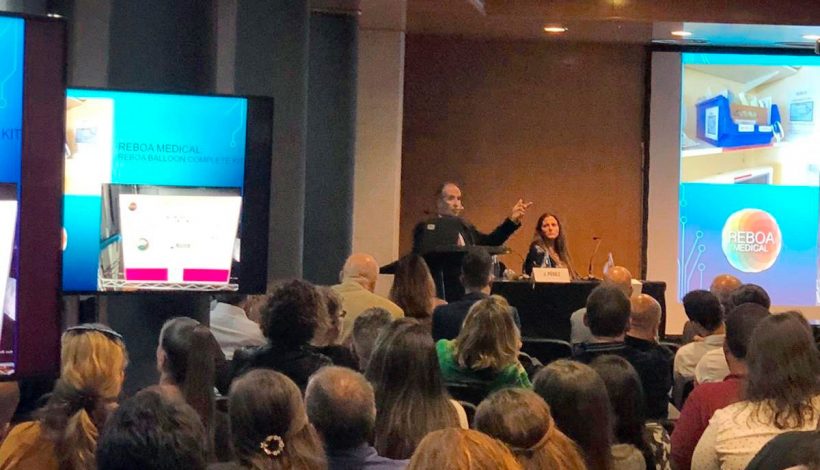
“As part of the 31st Extraordinary Meeting of the Valencian Society of Surgery held yesterday in Benicàssim, the General Hospital of Castellón, in collaboration with the Prehospital Critical Care (PHCC) group, introduced a new device to emergency medical professionals. This device is presented as an interesting alternative that could be crucial in saving lives during the “bous al carrer” (bull running) events.
This medical technique has been brought to this province by Andreu Martínez, a surgeon at the hospital and a member of PHCC, created in 2021 in Xàbia by Dr. Rosana Chorro and nurse Andrés Climent. Their goal is to extend the use of the REBOA device (Resuscitative Endovascular Balloon Occlusion of the Aorta) to prehospital emergencies.
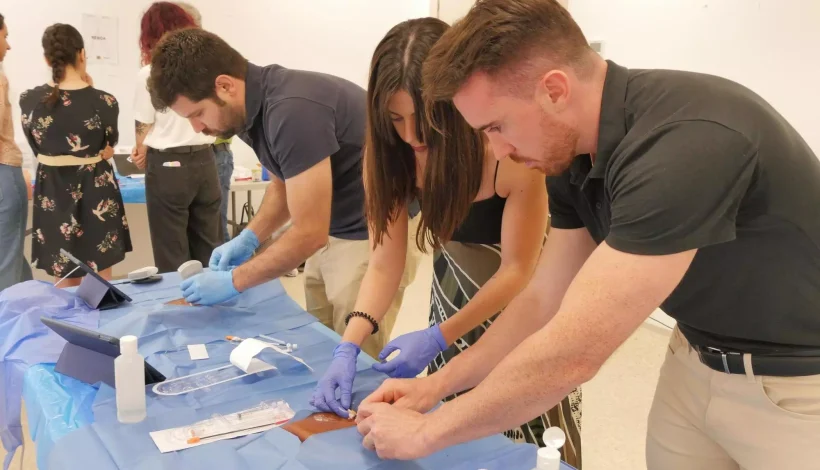
Professionals specializing in extreme emergency street assistance focus on training for specialization, and for this purpose, they have created their own simulator, “a 3D-printed silicone mold that contains a vein and a femoral artery with pulsatile flow,” allowing high-reliability practice with this new resuscitation technique, thereby learning to use it in “critical and highly stressful” situations. Yesterday in Castellón was “the first time in Spain” that they provided an introduction to this training for surgeons; so far, they have trained doctors and healthcare professionals from SAMU and similar services.
The use of techniques similar to REBOA is common in operating rooms. At PHCC, they saw this device as an opportunity to improve care in traffic accidents, stab or gunshot wounds, and especially in this region, bull goring injuries. In extreme risk situations, “you encounter patients with bleeding wounds that cannot be compressed or have a tourniquet applied, and it’s a matter of time to stop the bleeding.”
The Special Case of Gorings
In gorings, Martínez explains, “the patient is very complex because not only does he have a penetrating wound from a horn, but he also presents with blunt trauma from the impact of the goring, and his condition evolves dynamically.”
The most severe hemorrhages usually occur “in confluence zones, such as abdominopelvic or thoracoabdominal areas, where pressure cannot be applied to stop the bleeding. Therefore, this device, in a minimally invasive way, can temporarily stop the bleeding until reaching the hospital,” thus facilitating the stabilization of other injuries, some of which are life-threatening.
The manager of the Castellón Health Department, Raúl Ferrando, defended this proposal for care evolution, stating that “the number of festivities in this province is very high, and we will have patients who will require treatment. Seeking the best way to assist them is an obligation.”
Taken from the article in Periódico del Mediterráneo, read here.